Personal project · In development
CPS Studio
Simulating a society
A simulation in which AI-driven residents have their own relationships, routines and memories.
I’m designing and building CPS for researchers and game developers, exploring how current language models can support a society that develops over time.
See CPS in action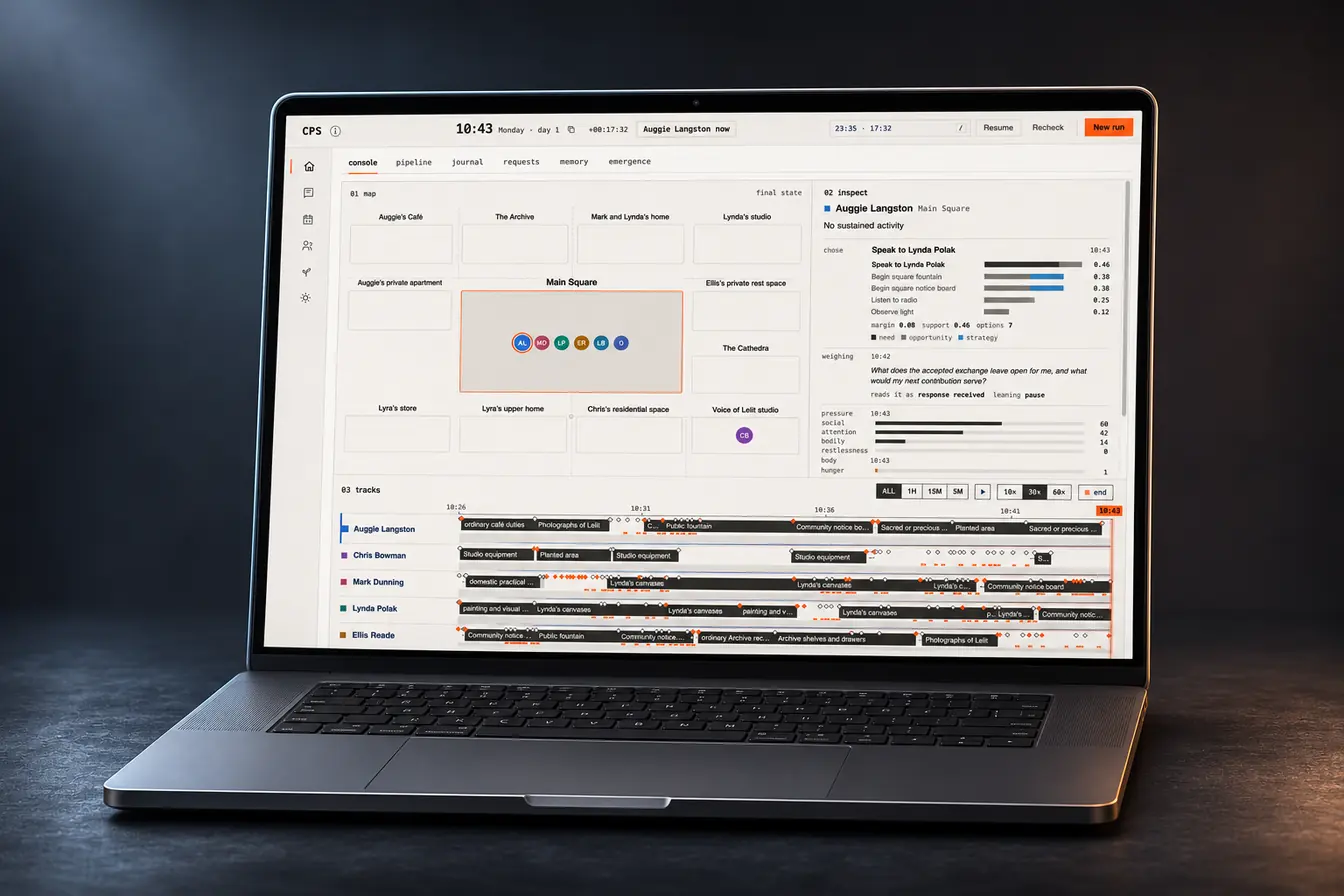
- Role
- Product design & development
- Intended audience
- Researchers & game developers
- Focus
- Simulation, behaviour & memory
- Status
- Working prototype · Planned release
The starting question
Can a simulated society build a shared history?
I began by asking how far publicly available language models could go beyond a single conversation. I wanted to create a synthetic society: simulated residents with distinct identities, places and relationships, whose encounters could influence what happened next.
CPS is the simulation framework. CPS Studio is the browser workspace for observing it and investigating its behaviour. The screens show Lelit, the current setting with seven residents. It is one setting the framework can support.
The system behind the experience
A changing society. A defined set of rules.
I explored a deterministic framework around language models: the simulation defines each resident’s situation and available actions, validates proposed changes and records accepted events. Model output can vary; the rules determine how it can affect the world.
- 01
Establish the context
Each resident has a place, relationships, needs and their own record of experience.
- 02
Choose within limits
Local rules compare available actions. Model judgments provide advice within that context.
- 03
Check and record
The simulation validates actions and proposed speech before accepting a change.
- 04
Carry experience forward
Accepted events can become personal experience and inform later choices.
Designing the workspace
Make behaviour possible to follow.
The interface needs to answer two connected questions: what is happening in the society, and what is happening for one resident? I gave each question a view, with access to the records behind it.
01 / 05
Conversations
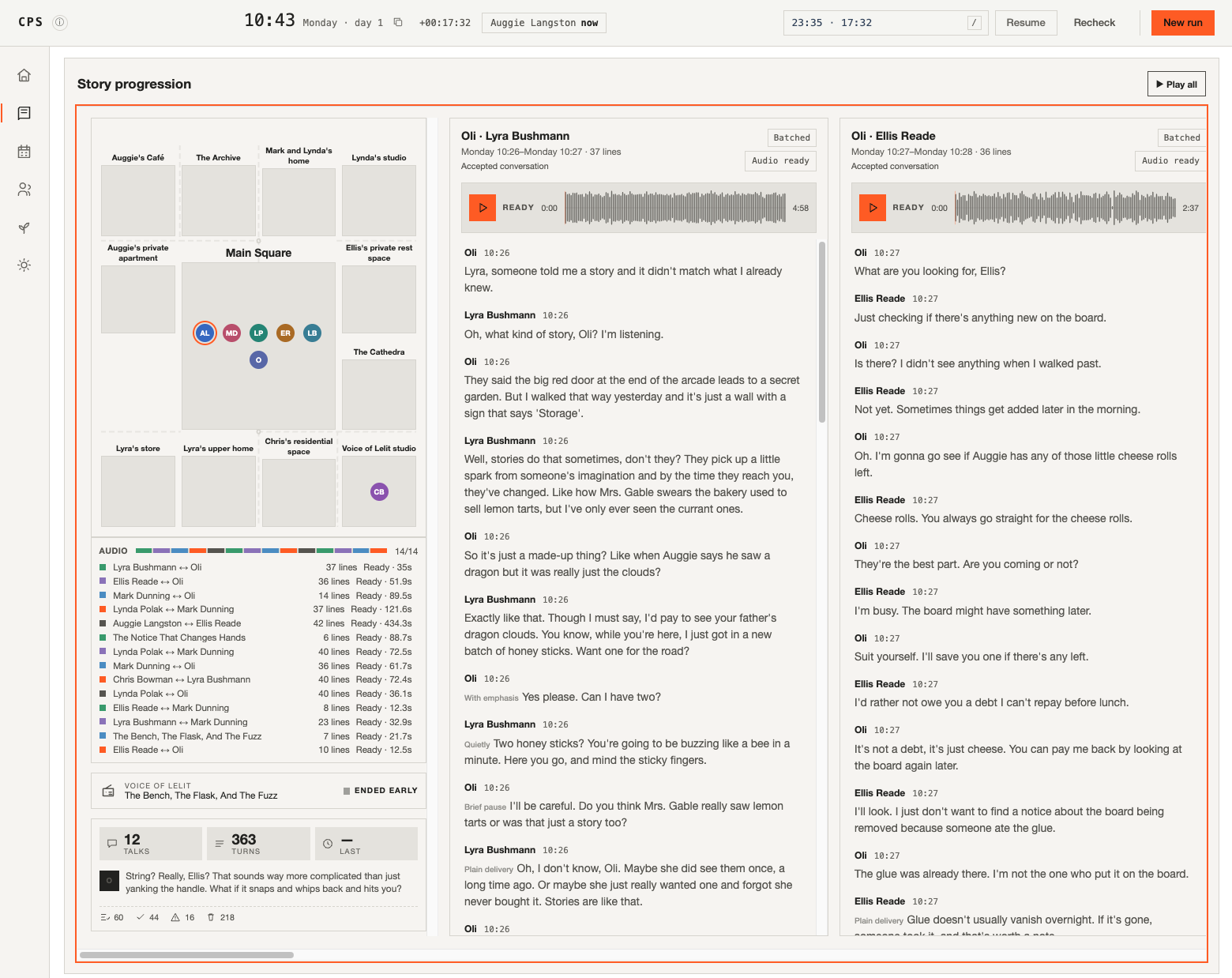
I placed the world map beside the dialogue. You can follow what residents said, see where they were and listen to recorded exchanges without moving into technical logs.
02 / 05
Individual choices
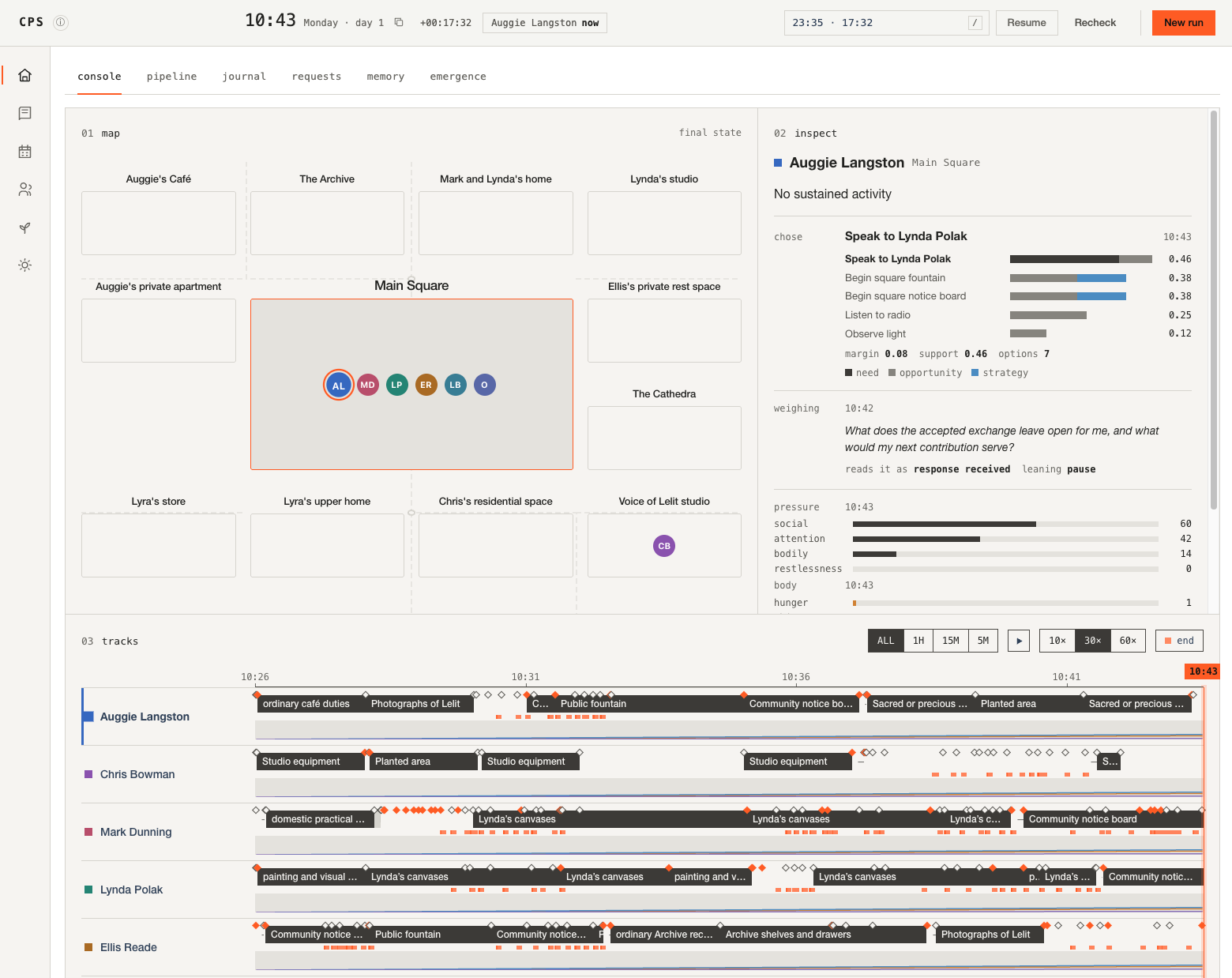
Selecting a resident reveals the options considered and the context behind the choice. The activity tracks add a view over time, helping someone investigate a particular moment in a longer run.
03 / 05
Plans & activity
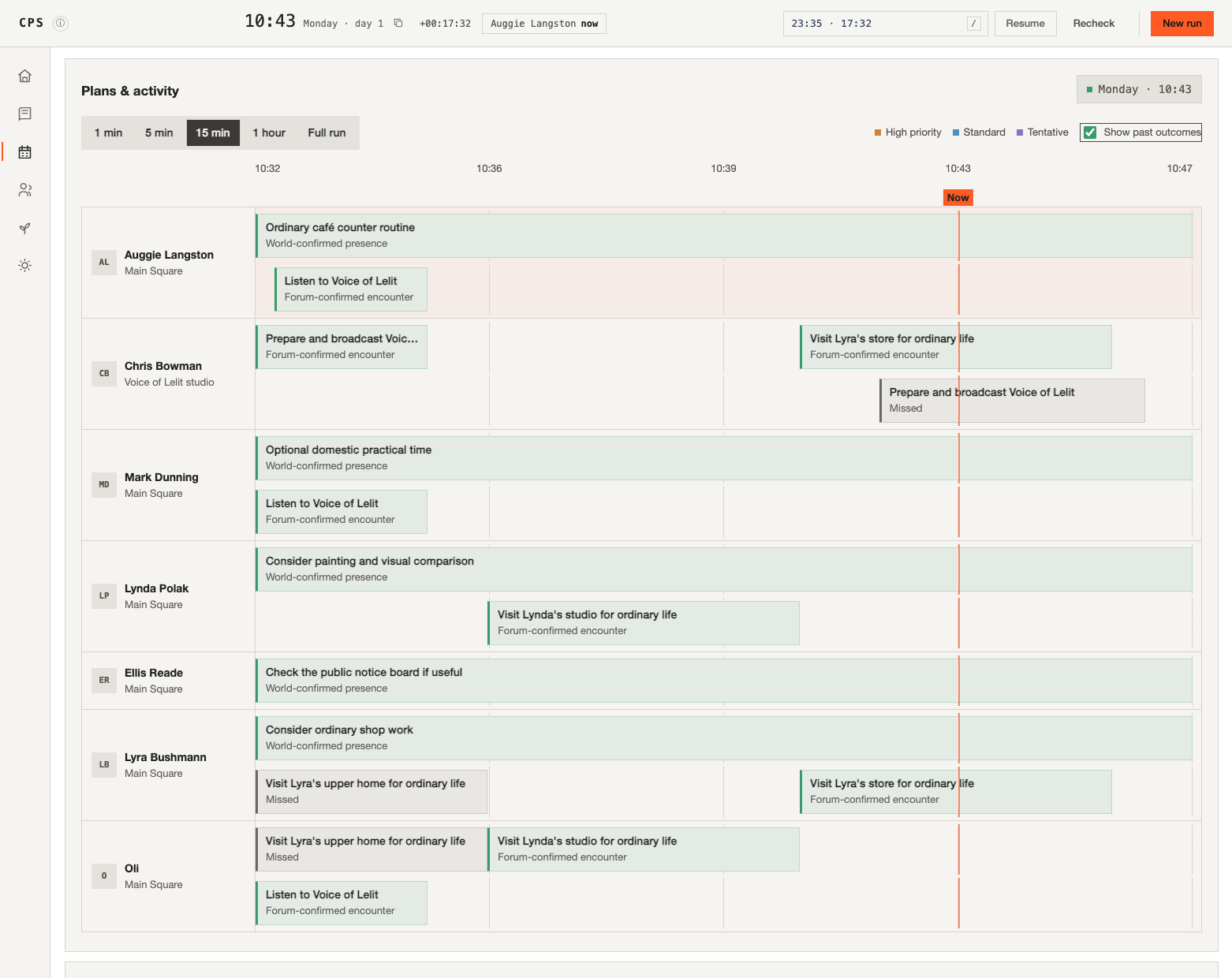
A plan tells us what a resident intended to do. The activity record shows what followed. I brought them together on a shared timeline, making missed commitments and changing routines visible across the cast.
04 / 05
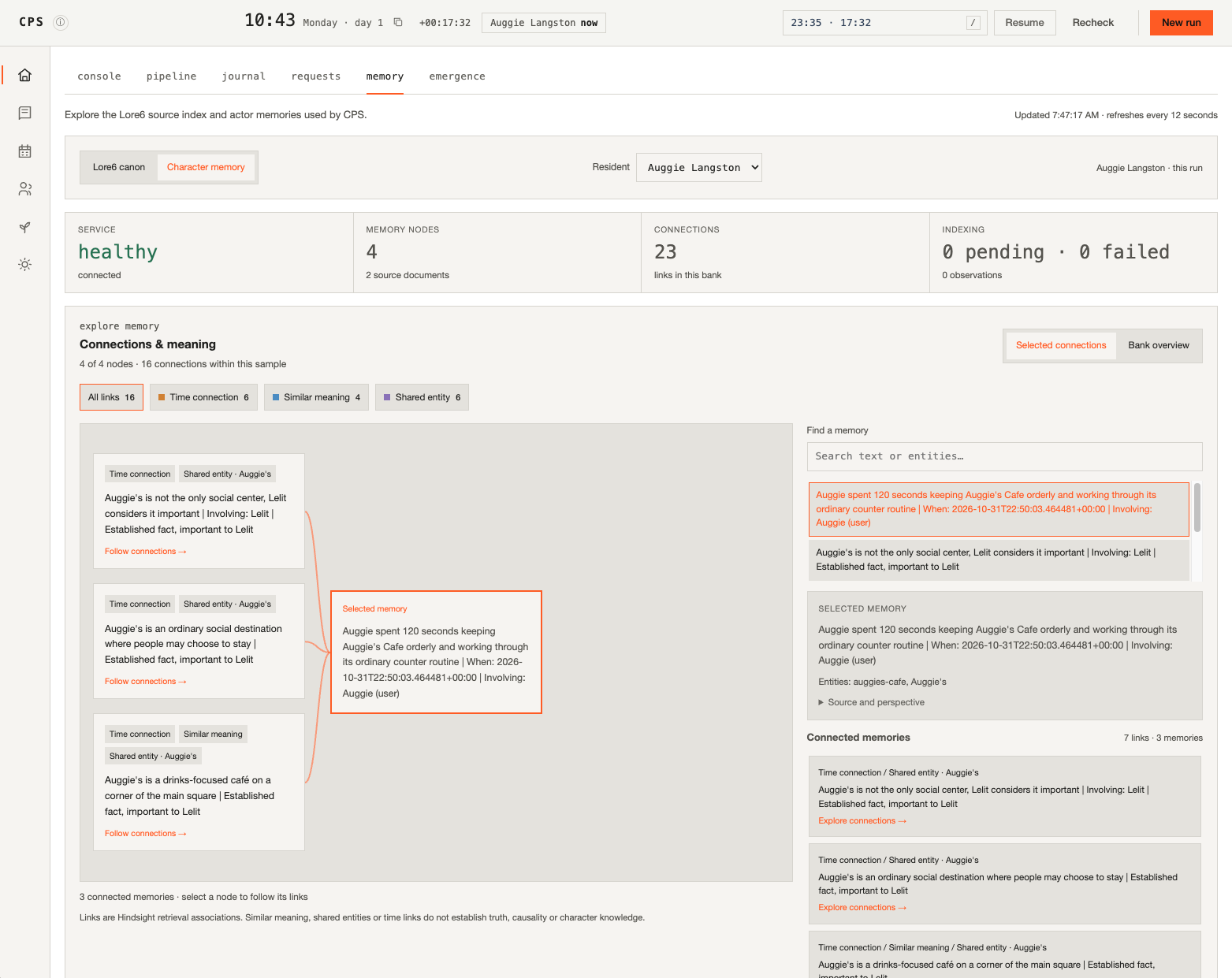
Resident memory
Residents have separate records of experience. I designed this view around selecting a resident, finding a memory and following its connections, with the source accessible alongside it.
05 / 05
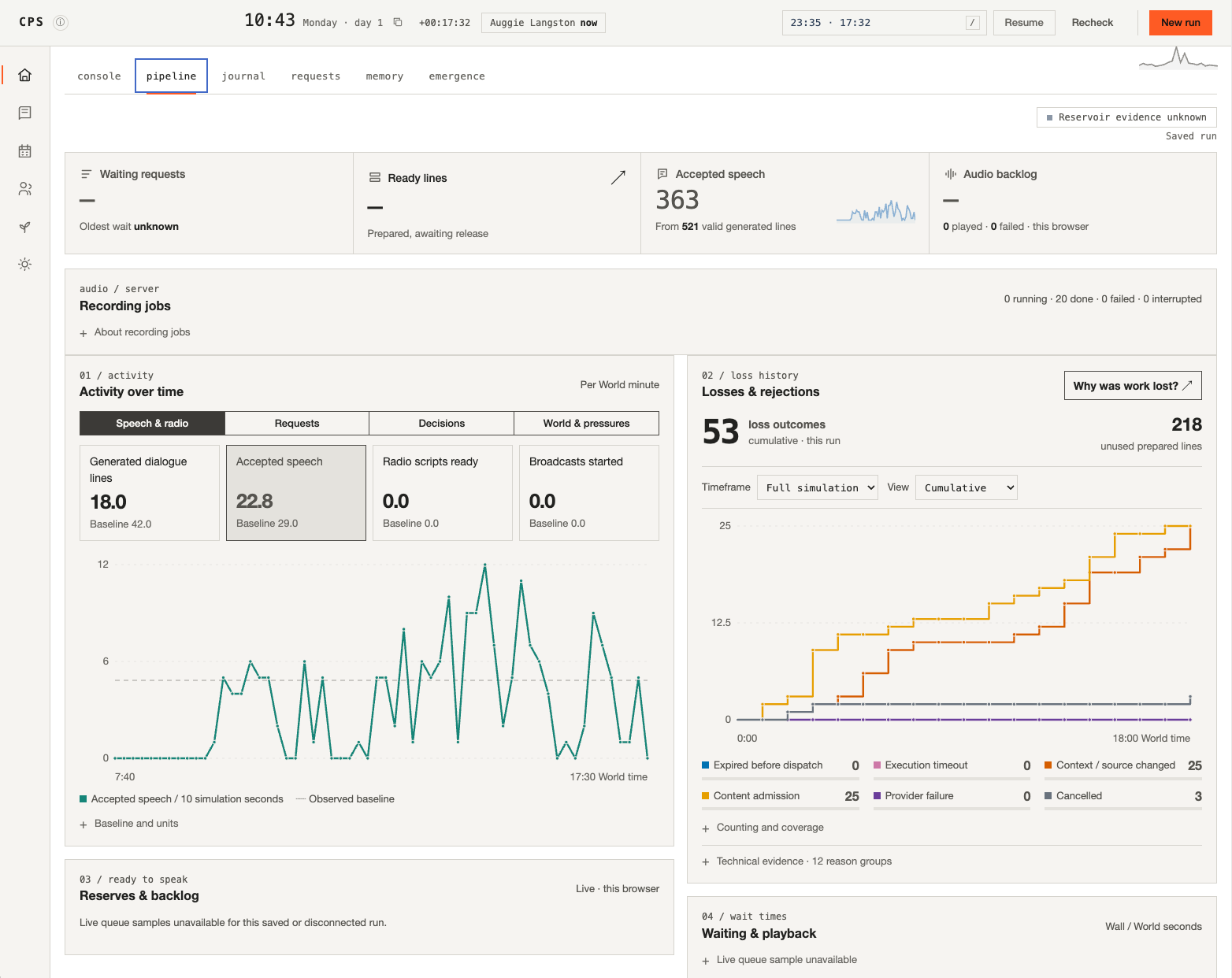
System activity
A quiet simulation can mean a resident is waiting, a model is processing a request, or dialogue has been rejected. Queues, accepted speech and loss charts help investigate what is happening behind the story.
Work in progress
Building towards a release for research and games.
My contribution
I’m developing the project from the initial idea through the simulation rules, interface design and implementation. It brings my UX and UI practice together with software development using AI-powered workflows.
The next stage
CPS is a working personal prototype that I intend to release for researchers and game developers. The next work is to test longer sessions: whether conversations stay coherent, memories remain useful and the society develops without an increasing processing backlog.
Let’s work together
What could be easier to use?
Tell me about the product and the part that needs fixing. A few sentences is enough.
Tell me about it