Listening does not scale
Real-time playback was the only way to know what a recording contained.
Client project · Audio archive platform
Every hour of the archive, searchable to the second.
A research and cataloguing workspace for a sound archive holding six decades of oral history, broadcast and field recordings. AudioMeta lets archivists and researchers listen, read, search, tag and assemble material in one place — with the transcript and the playhead moving as one.
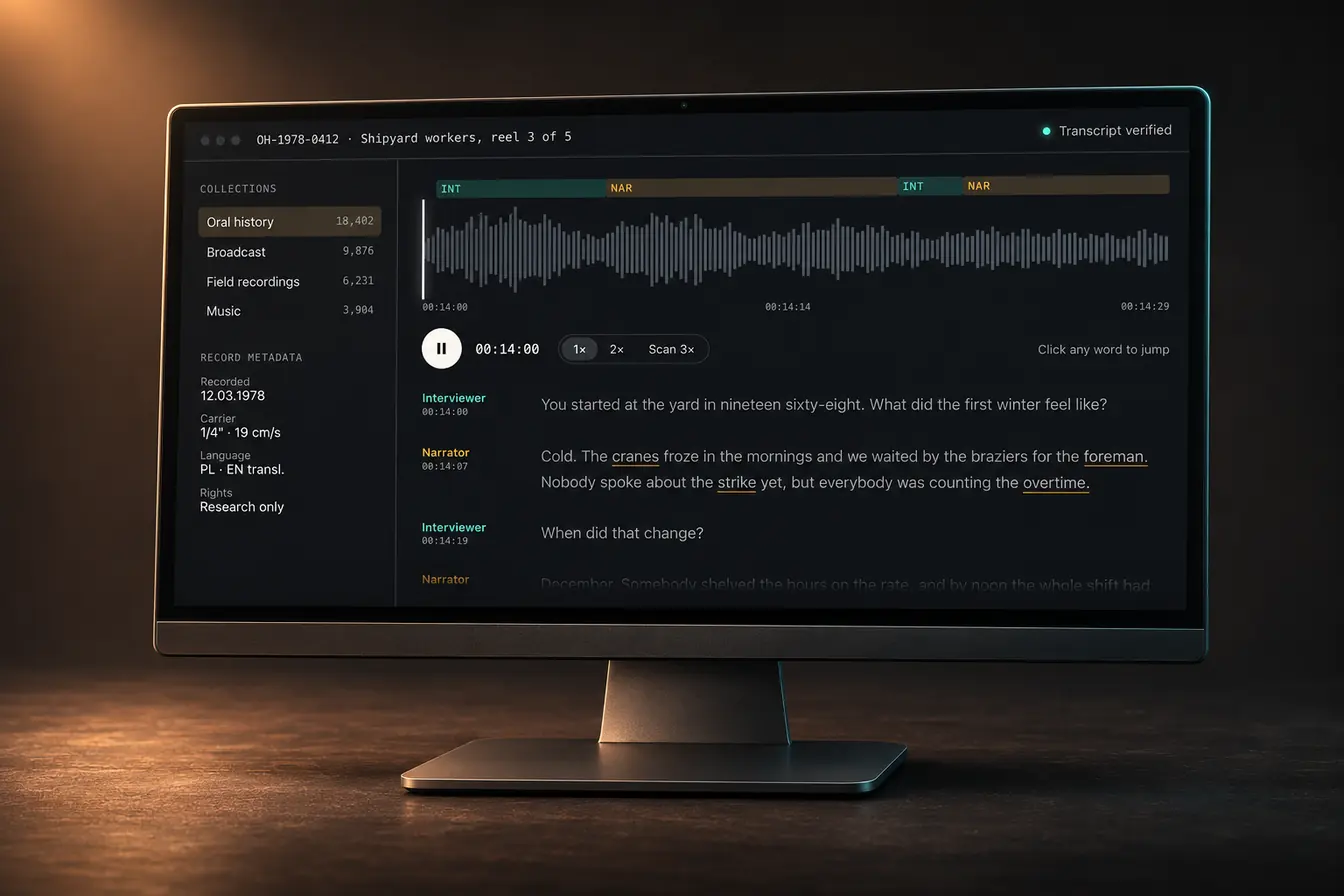
Try the synchronised player
Live preview — illustrative recording and transcript. Terms in amber are linked to the archive’s controlled vocabulary.
The context
The archive had digitised decades of reel-to-reel tape, cassettes and broadcast masters. The sound was safe. Finding anything in it was not.
Catalogue records were inherited from card indexes and three generations of spreadsheets. A typical entry held a title, a date and a reel number. To answer a researcher’s question, a cataloguer listened in real time, took notes by hand and replied days later. Valuable passages were found once, then lost again.
Real-time playback was the only way to know what a recording contained.
Inconsistent fields, free-text tags and duplicate names made search unreliable.
Each research request started from zero; nothing was saved back to the source.
Listen & read
The transcript and the waveform share a single timeline. Wherever you are in one, you are in the other.
Words are aligned to the audio at word level, so clicking a sentence starts playback exactly there, and the active phrase follows the playhead as it moves. Speaker lanes above the waveform show the shape of a conversation before you hear a second of it.
Pitch-corrected playback up to 3×, with silence and tape hiss compressed out. An hour-long interview can be surveyed in under fifteen minutes.
Move between speaker turns, chapters, tagged moments or search hits with the keyboard — never by dragging a scrubber and hoping.
Transcripts are editable while you listen. Each correction keeps its author and timestamp, so verified text is clearly separated from machine output.
Search
Search runs across transcripts, catalogue metadata and acoustic features at once — and every result lands on a moment, not a file.
Simple queries behave like a search box. Specialists can combine proximity, speaker, place, decade, carrier, rights status and detected content such as music or applause. Queries can be saved, shared and turned into live collections that update as new material is catalogued.
"overtime" NEAR/12 strike · decade:1970s · speaker:narrator…everybody was counting the overtime. Nobody spoke about the strike yet…
…the overtime lists were posted, and that was the morning the strike began…
…they refused overtime first. The strike was a week behind it…
topic:housing AND place:"Nowa Huta" AND NOT speaker:interviewer…we got the keys in March, two rooms and a kitchen, the plaster still wet…
…this block was meant for the steelworkers, the school came later…
…my mother still calls it the new flat, fifty years on…
status:untagged AND duration:>30m AND has:music · sort:oldestNo transcript match — music detected across 92% of the runtime.
Language identified: Polish, Latin. Two speakers before the performance.
Speech and music interleaved. Suggested topic: Celebrations (review).
Tag & classify
Tags are anchored to time ranges, drawn from the archive’s controlled vocabulary and always attributed.
Automated analysis proposes topics, places, people and content types. Each suggestion shows its evidence and waits for a person to accept, refine or reject it. Batch tools let a cataloguer apply a decision across hundreds of recordings while seeing exactly what will change.
Taxonomy
Suggestions for 00:14:02 – 00:15:40
Patterns
Any query can be viewed as a distribution — across decades, places, speakers or collections.
Researchers spot where a theme rises, disappears or moves between communities, then click a cell to hear the passages behind it. Curators use the same view to find under-described parts of the collection and plan cataloguing work.
Bespoke records
Passages from different recordings can be gathered into a curated record — an exhibit, a research dossier, a broadcast package.
Every clip keeps its link to the source, its rights status and its citation. Records can be annotated, versioned and exported as a finding aid, a citation list or a cleared audio package, and they become searchable objects in the archive themselves.
Record · R-2025-017
How we got there
Sat with cataloguers and reading-room staff, mapped twelve real research requests end to end.
Defined the passage as the core unit, reconciled legacy fields into a single schema and vocabulary.
Tested the synchronised player and query builder on the archive’s own recordings, every two weeks.
Built a component library with engineering, migrated collections in phases, trained staff on site.
Outcome
The archive stopped being a store of tapes and became a body of evidence people can question. Research requests are answered with timestamps, not apologies — and every answer makes the next one faster.
Let’s work together
Tell me about the product and the part that needs fixing. A few sentences is enough.
Tell me about it